LinkedIn Voices: Jonathan Haidt

Jonathan Haidt has emerged as one of the most influential public intellectuals of our time, a social psychologist bridging moral philosophy, business ethics, and cultural psychology to explain how our societies think, divide, and heal. As a professor at NYU Stern School of Business and the author of bestsellers like The Righteous Mind, The Coddling of the American Mind, and The Anxious Generation, Haidt’s work is shaping how educators, policymakers, and parents understand morality, mental health, and the modern digital crisis.
Who Is Jonathan Haidt?
Jonathan Haidt is a social psychologist and professor at New York University’s Stern School of Business. His work explores how morality and emotion shape culture, politics, and institutions.
He first gained prominence with The Righteous Mind: Why Good People Are Divided by Politics and Religion (2012), which examined the moral roots of ideological conflict. His later works; The Coddling of the American Mind with Greg Lukianoff (2018) and The Anxious Generation (2024); expanded his focus to how generational and technological shifts are transforming mental health, education, and democracy itself.
Haidt’s mission is simple yet urgent:
“To understand moral psychology, and use it to help societies function with greater wisdom and cooperation.”
Through his initiatives such as EthicalSystems.org and AfterBabel.com, he aims to rebuild the moral foundations of education, organizations, and online culture.
From Moral Psychology to Social Repair
Haidt began his academic career studying moral emotions, like disgust, gratitude, and elevation, and how they bind communities together. But as digital platforms reshaped behavior, he noticed that the same psychological principles were being exploited to divide and distract societies.
His pivot toward cultural diagnosis began after observing rising polarization and mental health crises among youth. In The Anxious Generation, Haidt presents a striking argument: the “Great Rewiring of Childhood”; driven by smartphones and social media; has created an epidemic of anxiety, depression, and attention dysfunction.
He argues that we have traded free play, real relationships, and community-based learning for digital dopamine loops, and the cost is staggering.
His research calls for nothing less than a generational recalibration:
Delay smartphones until at least age 14–16.
Ban phones in schools.
Rebuild local communities and unstructured play.
These recommendations have already influenced school districts, parenting groups, and policymakers worldwide.
Mission: Rebuilding Moral Capital
At NYU Stern, Haidt applies moral psychology to organizational ethics. His team at Ethical Systems gathers research on integrity, transparency, and culture-building, helping firms enhance both performance and moral capital.
His philosophy challenges short-termism and moral decay in corporate life:
“Better systems produce better people.”
This principle underpins his work with executives and educators alike, building institutions that discourage cheating, promote cooperation, and restore trust.
Beyond academia, Haidt engages in public dialogue through initiatives like The Asteroids Club and CivilPolitics.org, both focused on bridging partisan divides through empathy and shared understanding.
Themes & Message Pillars
The Digital Rewiring of Childhood
Children’s mental health is collapsing under the weight of social media addiction.
The solution lies in restoring real-world childhood: outdoor play, face-to-face friendship, and phone-free schools.
Moral Psychology in a Polarized World
Our “moral taste buds” differ across political lines, understanding them is key to cooperation, not conflict.
Ethical Systems & Institutional Integrity
Organizations thrive when they cultivate ethical cultures instead of compliance checklists.
Moral capital is a measurable performance advantage.
Reclaiming Attention and Meaning
In the attention economy, moral resilience and focus are the new superpowers.
“If we can’t control our attention, we can’t control our lives.”
LinkedIn Content Strategy: Thought Leadership with Depth
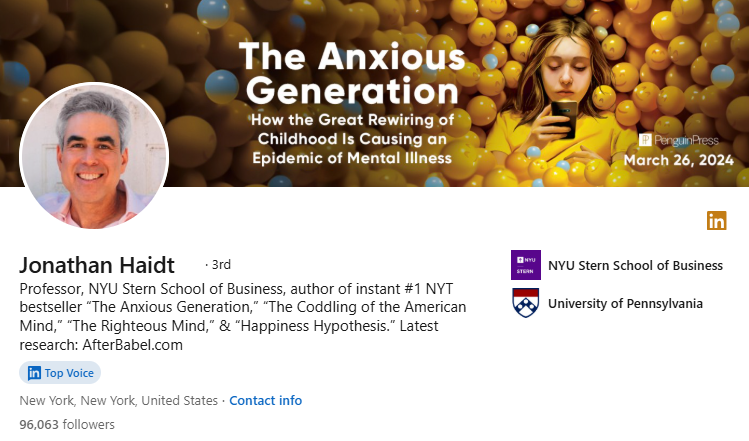
On LinkedIn, Jonathan Haidt’s content blends scholarship with social urgency. He writes not to promote, but to provoke reflection.
Strategy Highlights:
Educational Storytelling: Each post links empirical findings with cultural relevance — from the dangers of smartphone overuse to solutions for the “boy crisis.”
Collaborative Advocacy: Partners with thought leaders like Freya India and Gabriela Nguyen to promote campaigns such as Time to Refuse, encouraging Gen Z to reclaim real life from screens.
Public Discourse: Amplifies testimony and hearings on tech safety, especially around AI companions, children’s mental health, and policy reform.
Action-Oriented Awareness: Posts often include free guides, petitions, or links to community projects like Project Healthy Minds or AfterBabel.com.
Tone & Style:
Rational yet urgent.
Rooted in data, driven by humanity.
A balance of academic rigor and public compassion.
Some of Jonathan Haidt's Posts on LinkedIn

Why Jonathan Haidt Matters
Jonathan Haidt stands at the intersection of science, ethics, and culture, a rare public thinker whose research transcends academia to shape daily life.
He’s not merely warning about the crisis of attention, polarization, or moral decline, he’s building blueprints for renewal.
In an age of outrage and noise, Haidt’s work reminds us that understanding (not anger) is the foundation of progress.
“If we want to raise wiser kids, build stronger institutions, and save our democracy, we must first repair our social fabric, starting with how we connect, play, and think.” – Jonathan Haidt
Some of His Talks & Series
Profile Summary
Info | Detail |
Name | Jonathan Haidt |
Title | Professor, NYU Stern School of Business |
Focus | Moral Psychology, Ethics, Youth Mental Health, Digital Culture |
Experience | 25+ years in academia; global speaker and author |
Publications | The Anxious Generation, The Coddling of the American Mind, The Righteous Mind, The Happiness Hypothesis |
Platform Reach | 1M+ followers across LinkedIn, Substack, and media |
Notable Achievements | #1 NYT Bestselling Author, TED Speaker, Top Voice on LinkedIn |
Research Platforms | |
Location | New York, USA |